
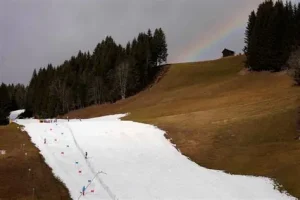
 Many of the Rocky Mountain US states are experiencing the worst snow conditions in history – limited runs are available and resort visits are down by 20 percent compared to most years.
The knee-jerk reaction of most resorts has been to cut jobs and limit employee hours to balance their books (although notably not Loveland ski resort, which enjoys more enlightened leadership). Seasonal ski resort employees typically arrive from many different countries, so cutting their hours or laying them off is devastating for them.
Why is this happening? Because “the shareholder” is the main focus for many of these companies. Their mantra is that shareholder returns and value must be protected at all costs, and everything else is second. As I have argued for decades, this is upside-down thinking. If we take care of employees and treat them with compassion, dignity, respect and love, they will build amazing organizations that reward shareholders. But this is a long game, and most leaders play a short, 90-day window game.
Let me share a true story from my 2006 book “ONE: The Art and Practice of Conscious Leadership” that demonstrates how treating employees well, regardless of economic disappointments always pays off.
What Goes Around Comes Around
Kirk Hoessle’s office is a million acres of rugged green wilderness. Originally from Missouri, Kirk obtained a degree in Environmental Education and Outdoor Recreation, and then headed for the Alaskan wildlands. In 1982, he guided tent safaris for adventurers in Alaska’s spectacular backcountry—Kenai National Wildlife Refuge, the Chugach National Forest, and Denali National Park. In those days, 50 fortunate beings soothed their souls each year on these wilderness raptures. Hoessle loved his work so much he decided to acquire the company he worked for, building it from those early beginnings into today’s Alaska Wildland Adventures, an award-winning ecotourism firm, which employs 12 year-round and 80 seasonal staff. Each year, the company operates tours for over one thousand guests visiting the Alaskan interior—some staying in tents, but most overnighting in authentic Alaskan log cabins. In 2005, Alaska Wildland Adventures counted former U.S. President Jimmy Carter and his wife among its guests.
Kirk’s early experience as a guide and an employee in the company he now owns raised his awareness of how critical serving employees is to the success of a business. “I still remember what it was like to be an employee, and I know that my company’s product absolutely depends on its employees and their interaction with customers,” he says. “As an ecotourism company, we also recognize the oneness of people and the environment, and we serve them both as one.”
Hoessle has worked hard to serve the natural desire for trust and open communication with all employees. He practices open-book management, helping to build a sense of “family” through the honest sharing of the company’s financial information. A revenue sharing plan is in place, and employees are surveyed annually for their ideas on improving operations, with the results being communicated at the beginning of each season. Hoessle also delegates much of the decision-making to department managers, who in turn are encouraged to delegate decisions to committees, and, where possible, individual workers. With access to financial information, employees can make informed spending decisions, arrange their own holiday schedules, and use their discretion on many matters. Alaska Wildlands’ employees enjoy their work so much that the majority of them return each year.
And their enjoyment is patently visible to outsiders—Glenda Denny heard about the company when she was working at a nearby hotel. Listening to the enthusiasm and passion of Alaska Wildland’s guides convinced her to join the company. “They were all so knowledgeable and you could tell that they loved their jobs,” she says. Forty percent of guests are returning customers—some of whom have been taking fishing trips for 15 years.
The aftermath of 9/11 was devastating for Alaska Wildlands, and Hoessle was forced to make difficult choices. But he involved his team in the decisions, inviting them to contribute their ideas to weathering the downturn. Rather than simply issuing pink slips to trim overhead, the company offered its employees the opportunity to take 30 days off work without pay. Some chose to take their time off all at once; others chose to work four-day weeks, and Hoessle gave loans to those facing hardship as a result of the new schedules. Employees were encouraged to make use of the different lodges the company operates during the off-season—Kirk wanted to be sure the company was helping them during these hard times.
Greater challenges were to come. Early during the summer of 2003, lightning struck a designated wilderness area located on a remote mountain slope only two miles away from Kenai Backcountry Lodge owned and operated by Alaska Wildland Adventures, causing a smoldering fire. In Alaska’s designated wilderness, a wildfire is considered to be a natural part of the ecosystem and is allowed to burn unless there is a danger of its going out of control or the fire appears to threaten structures or critical areas. So the fire caused by the lighting strike was left to smolder. The summer of 2003 was unusually dry, and eventually Kenai Backcountry Lodge’s primary water supply, based on a spring-fed stream, dried up for the very first time in the company’s history. This was the first signal to management that there was a high risk for the fire to get out of control.
Hoessle’s team phoned the Alaskan State fire management agencies almost daily in late July and early August, requesting action to fight the fire, but they did not respond immediately because they did not accurately assess the devastating potential of this fire.
On August 10, Hoessle received a phone call in his Girdwood office, about a three-hour drive and boat ride from Kenai Backcountry Lodge. The call was from a resident on the far side of the lake across from the lodge, advising that smoke could be seen billowing up from the shore. Alarmed, Hoessle called the lodge manager, who, after riding a boat out into the lake, confirmed that the fire was indeed raging down toward the lake—and the Kenai Backcountry Lodge was in its path. Hoessle’s team immediately evacuated the eight-cabin lodge, making alternative arrangements for the guests.
After contacting Kenai National Wildlife Refuge, responsible for alerting the Alaska State fire control, Hoessle and two other staff members went home to pack sleeping bags, appropriate clothing, chain-saws, and any equipment they thought might be useful, and drove off toward Kenai Backcountry Lodge. There, with the help of lodge staff, they used the lodge’s own hoses and emergency pumps to wet down the buildings. They also worked to create a fire-break around the lodge property by cutting down trees and bushes in a fire-break line to prevent the fire from reaching the lodge and guest cabins. Late in the evening, an eight-person fire-fighting crew arrived by boat, but, disappointingly for Hoessle and his team, left again when winds kicked up, creating additional danger, and advised Hoessle and his staff to leave the site, too.
Realizing that he would need to mobilize additional people to help save the lodge, if this was at all possible, Hoessle put in a call late that evening to Kevin McDermott, a former employee who now owned a construction firm. Without hesitation, McDermott agreed to bring his crew up to Kenai Backcountry Lodge to help fight the fire. He also contacted another former employee, Dennis Weber, who in turn called his brother Mike and his wife Jen. Dennis, Mike, and Jen wasted no time, leaving that evening, packing their own chain-saws and other equipment and driving through the night to reach the site by early morning. All of the people in this group, including Mike, Jen, and McDermott’s crew, were former employees of Alaska Wildland.
From six in the morning until noon, eighteen employees and ex-employees worked as one to fight the fire—and then, the first fire fighter crews arrived. The employee crew worked all day to cut the fire line. No one asked if, or how much, they would be paid. “A week later,” Hoessle remembers, “I handed them all checks, and I had to really work hard to get them to take the money.”
Kenai Backcountry Lodge, a crucial component of Alaska Wildland Adventures’ business, was saved thanks to the efforts of former employees whose commitment to the company did not end when they chose to pursue different careers.
Having started out as a guide in the company, Hoessle is very much aware of how serving others creates staff satisfaction and effectiveness. And others on his team have shared the same experience—Kyle Kelly started as a driver, was promoted to trip leader, then program manager, and now is responsible for all of Alaska Wildland’s operations.
Hoessle knows that team members need to be respected, honored, and heard. He involves his staff in the decision processes on an ongoing basis. He believes in managing for results and not demoralizing people by micro-managing them. He upholds the principle that everyone respects everyone else, even when there is disagreement, and that it is important to first understand before one tries to be understood. Authentic listening is an important aspect of this practice. “People work here because they are attracted to our cause and environmental beliefs,” he says. “They stay because they are treated well.” Serving others is always a good investment.
“They stay because they are treated well”—that’s true for employees, customers, spouses, parishioners, partners, friends, or citizens. Serving others with the awareness that we are all connected, all interdependent, all one, is the best investment we can make in ourselves—because we are part of the one, too.
I partictipated in an activity organized y Lance Secretan so long ago that I no longer remember the details . Greetings, Lance, from Lake Malaga in the Eastern Townships of Quebec
Graham Weeks
Austin, Québec
Of course I remember Graham – Dawson College – all those years ago! Maybe its time to return to your tribe? We’d love to see more of you and experience your energy?